Question-and-Answer Resource for the Building Energy Modeling Community
Get started with the Help page
Ask Your Question

Revision history [back]

click to hide/show revision 1
initial version

BEopt Room AC % Conditioned

BEopt supports modelling the partial air conditioning of a home by selecting/setting an option with an "Energy Multiplier[frac]" less than one. The name of this parameter implies that it simply scales the energy use of the RAC(s) relative to 100% coverage, whereas the help file is a bit more nuanced.

Room air conditioners are modeled as conditioning the entire finished floor area. This multiplier can be used to adjust the cooling energy use to account for, e.g., when the system does not condition the entire living space.

How is the energy modelling for these partial load installations handled? I ask, because a quick check of the energy consumption of three RAC options with the same efficiency but different coverage produces some non-intuitive results. As can be seen below, they certainly aren't a simple percentage of the 100% coverage energy consumption, but they also do not show any moderating effects from partition walls potentially being at less extreme temperatures than ambient walls.
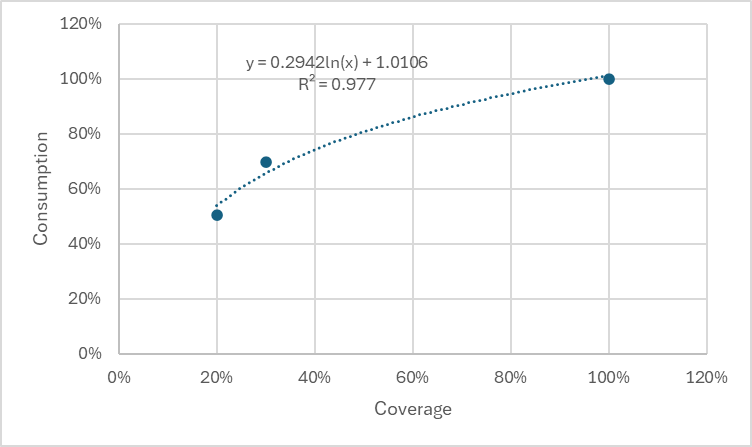
image description

BEopt Room AC % Conditioned

BEopt supports modelling the partial air conditioning of a home by selecting/setting an option with an "Energy Multiplier[frac]" less than one. The name of this parameter implies that it simply scales the energy use of the RAC(s) relative to 100% coverage, whereas the help file is a bit more nuanced.

Room air conditioners are modeled as conditioning the entire finished floor area. This multiplier can be used to adjust the cooling energy use to account for, e.g., when the system does not condition the entire living space.

How is the energy modelling for these partial load installations handled? I ask, because a quick check of the energy consumption of three RAC options with the same efficiency but different coverage produces some non-intuitive results. As can be seen below, they certainly aren't a simple percentage of the 100% coverage energy consumption, but they also do not show any moderating effects from partition walls potentially being at less extreme temperatures than ambient walls.

image description