Question-and-Answer Resource for the Building Energy Modeling Community
Get started with the Help page
Ask Your Question
4

Source and Derivation of Pump Performance Curves

asked 2026-10-15 01:03:21 -0600

Keigo's avatar

updated 2026-10-15 09:04:31 -0600

A previous post helped clarify the origin of fan performance curves.

I'm also curious about the source and derivation of pump performance curves.

The image below is from the ANSI/ASHRAE/IES Standard 90.1-2022 Performance Rating Method Reference Manual.
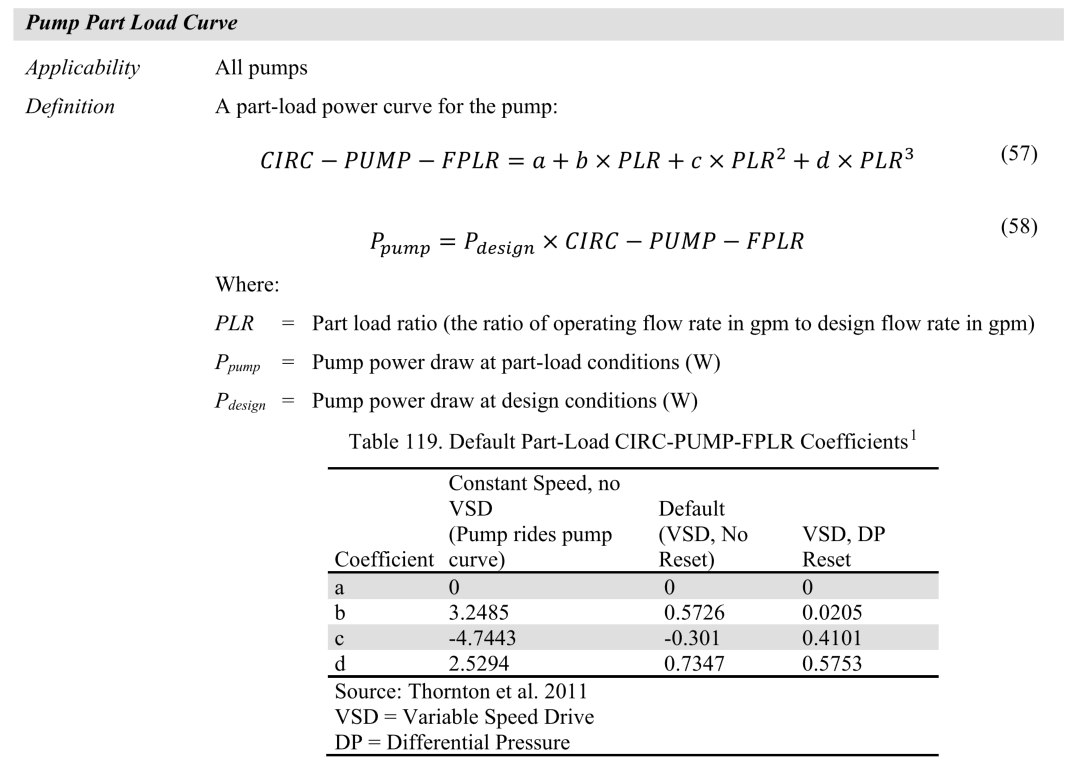
image description

  1. Constant-speed pump riding the pump curve: (0, 3.2485, -4.7443, 2.5294)
  2. Variable-speed pump without differential-pressure reset: (0, 0.5726, -0.3010, 0.7347)
  3. Variable-speed pump with differential-pressure reset: (0, 0.0205, 0.4101, 0.5753)

These coefficients are published in Table 5.21 of Achieving the 30% Goal: Energy and Cost Savings Analysis of ASHRAE Standard 90.1-2010 (Thornton et al., 2011), which only states that PNNL developed the three curves. I have not been able to trace the underlying data or derivation any further.

Does anyone know how these coefficients were originally derived?

edit retag flag offensive close merge delete

1 Answer

Sort by » oldest newest most voted
4

answered 2026-10-19 22:59:53 -0600

updated 2026-10-20 13:30:44 -0600

I believe the "Default" and "VSD, DP Reset" are curve coefficients from DOE2. They are listed in California's ACM Reference Manual Appendix 5.7: Performance Curves. The "Relevant To" column lists DOE2. However, I don't know the original source of these coefficients, or where the Constant Speed coefficients are from.

Update: I confirmed with some colleagues that all three curve coefficients were developed by PNNL in collaboration with the 90.1 Mechanical Subcommittee in 2009-2010. They were developed by fitting manufacturer pump curves at a representative 200 GPM / 60 ft design point for the three control strategies. The physical data was then fit with a zero-intercept cubic regression to satisfy EnergyPlus’s requirement that power equal zero at zero flow. I reviewed the workbook where the regression was done, but it was never published.

edit flag offensive delete link more

Comments

1

Thank you for taking the time to investigate this and confirm the details with your colleagues. Your explanation clears up something I had been wondering.

Keigo's avatar Keigo  ( 2026-10-20 20:47:12 -0600 )edit

Your Answer

Please start posting anonymously - your entry will be published after you log in or create a new account.

Add Answer

Question Tools

2 followers

Stats

Asked: 2026-10-15 01:03:21 -0600

Seen: 242 times

Last updated: Oct 26