I'm only vaguely familiar with the Massachusetts requirements, so please take the following with a grain of salt ...
I'm assuming you're referring to the example here (pages 19 to 21):
- an initial clear-field, effective Ro 22.5
- a final Rt 5.16 (once all linear thermal bridging is accounted for)
Correct me if I'm wrong. In any case, the linked example describes a similar outcome to what you're observing.
In this horror-story of an example, the postulated PSI factors are quite poor (what the Mass code refers to as prescribed). They are in the same range as ASHRAE's unmitigated PSI factors (Addendum AV). I see this example simply as a cautionary tale, a worse case scenario: "Careful, this may happen if one doesn't mitigate thermal bridging - so head's up". At the end of the example, they state "these prescriptive PSI values are based on details which have no thermal bridge mitigation."
The suggested solution in the example of course is to improve linear thermal bridging detailing (while leaving the Ro 22 as is). The outcome is much better if one relies on ASHRAE's default (i.e. mitigated) PSI factors, for instance.
FYI, ASHRAE 90.1 2022 prescriptive requirements make a clear distinction between:
- envelope clear-field, effective Ro requirements
- linear thermal bridging requirements (PSI factors)
ASHRAE doesn't confuse the two, and there is no prescriptive requirement to further derate any Ro values (with linear thermal bridging). Haven't checked, but if the Mass Energy Code holds prescriptive requirements to further derate Ro values with linear thermal bridging (giving a final Rt), then it starts to look like the Canadian NECB 2017 and 2020 (which are nearly impossible to meet, prescriptively).
ASHRAE does require users to derate constructions (based on PSI factors), strictly for modelling purposes:
- ECB (both proposed design and budget building models)
- App G (proposed design model only)
True, the App G baseline envelope doesn't factor any linear thermal bridging. So the proposed design model starts off disadvantaged (vs baseline). But this penalty may not be so significant. In the figure below, the X-axis represents insulated wall Ro factors (IP units), while the Y-axis holds corresponding Uo factors.
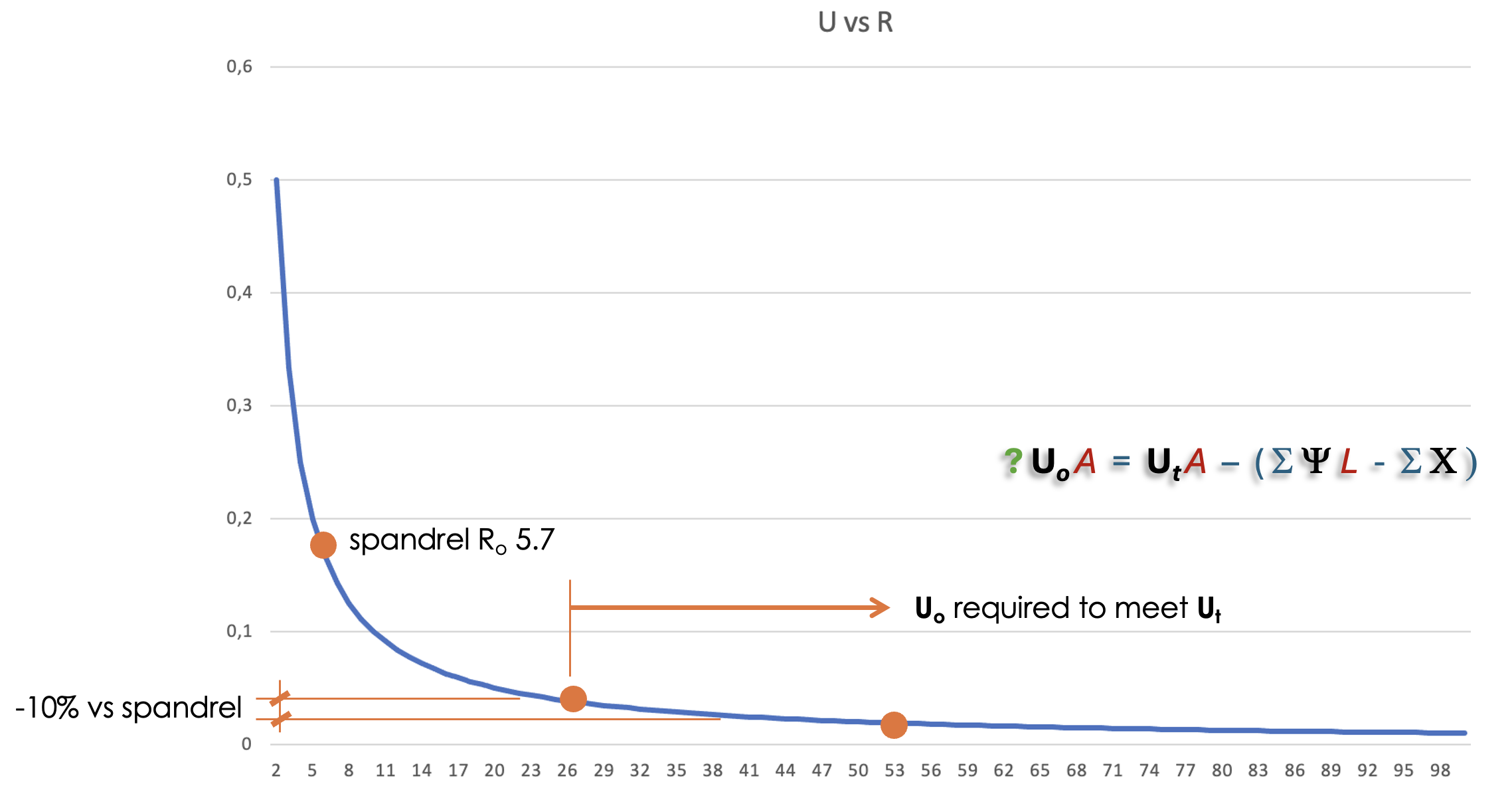
Going from an Ro ~6 (good curtainwall spandrel) to Ro 26 (non-spandrel, high performance), one can decrease the U factor quite significantly. Yet pushing for Ro 50+ only yields an additional 10% U-factor improvement (diminishing returns). This may translate to a 1 to 3 % penalty when using App G (cold climate simulations). I'm presuming a similar impact when following the Mass Energy Code performance path (Boston, CZ 3A), but I haven't taken a deeper dive. You can easily test this out.
Hope this helps.

.jpg "dradair")


