Question-and-Answer Resource for the Building Energy Modeling Community
Get started with the Help page
Ask Your Question
1

Why EnergyPlus does not report Conduction Heat Transfer for Window surfaces ?

asked 2026-02-26 15:10:00 -0500

Kashif72's avatar

updated 2026-02-26 17:27:25 -0500

I am studying and analyzing the Heat Balance across walls and windows of my single floor single zone box type model (developed in DesignBuilder and exported to EnergyPLus)

Later, I manually reported a lot of surface level outputs in IDF file in EnergyPlus (v23.1).

I noticed the Heat Balance is coming out right for Wall surfaces and for Net Heat Transfer across a WINDOW as well. However, there is no CONDUCTION reported for WINDOWS. I looked at all the outputs that EnergyPlus could report, but "EnergyPlus does not report any Conduction Heat Transfer for Windows" . WHY ?

I mean in Reality, there is some conduction heat gain and loss going on across windows. Then Why EnergyPlus is not considering it. Is it something that EnergyPlus does not distribute Window into several nodes and treat window as a single node which has a single Temperature (through whole width) ? OR AM i missing something.

Can Please someone explain.

I can share my Model and Excel sheet containing the heat balance analysis

Thank you for having this query

edit retag flag offensive close merge delete

1 Answer

Sort by ยป oldest newest most voted
2

answered 2026-02-27 07:09:08 -0500

Not sure the following answers all of your questions.

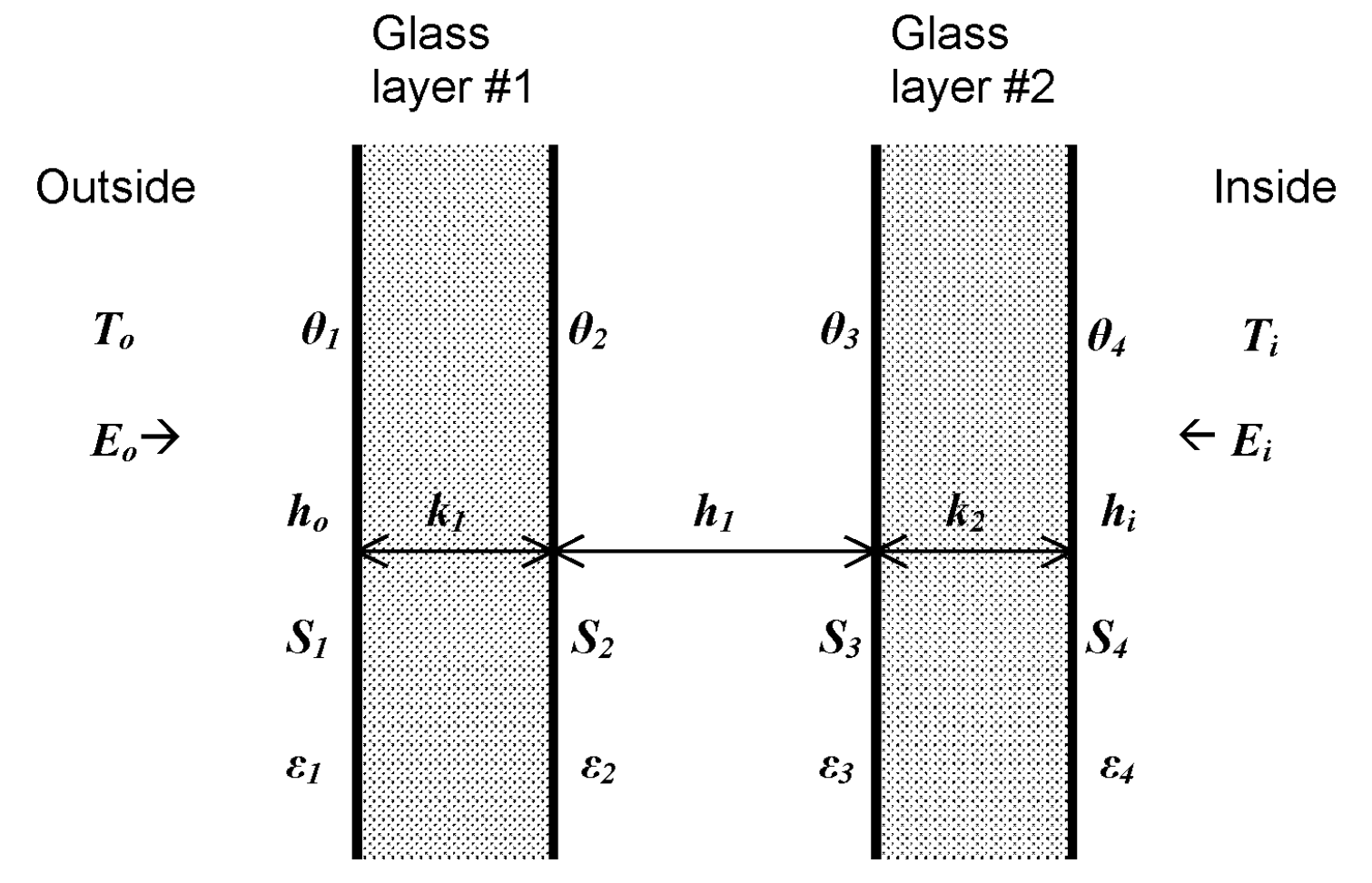
Taken from the EnergyPlus Engineering Reference, the following example breaks down time-varying environmental boundary conditions and material properties that affect glazing node/surface temperatures at each time-step. Glazing material conductivities (k1, k2 in the example) are most definitely taken into consideration.

image description

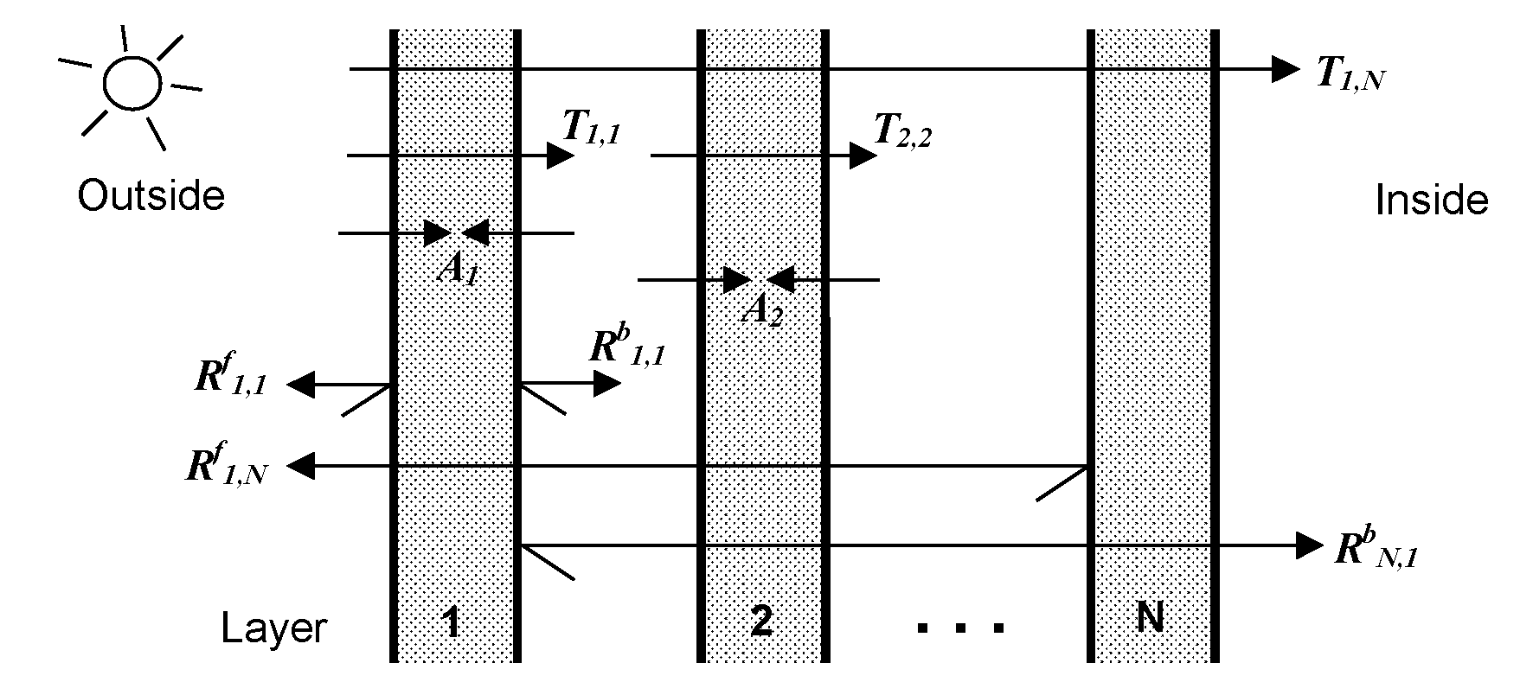
Let's take face S2. At any time step, its temperature will of course be affected by the glass layer conductivity (k1), but also by interpane gap convection and long-wave radiation, which are all ~simultaneously influenced by outside vs inside environments. And this is a simple example (no sun). Becomes more complicated with solar:

image description

... and even more so with blinds/shades, frames, etc.

Contrary to opaque constructions (e.g. walls), isolating a conduction-only component (vs long-wave radiation or convection) in a multilayered glazing assembly is not really feasible. I guess one can always approximate effective (or equivalent) glazing "conduction" by tracking over time the evolution of outside surface (S1) vs inside (S4) temperatures when the sun is set. Otherwise ...


I hope this is of some help ...


edit flag offensive delete link more

Comments

Thank you for answering. This helps.

Kashif72's avatar Kashif72  ( 2026-03-04 14:03:40 -0500 )edit

Your Answer

Please start posting anonymously - your entry will be published after you log in or create a new account.

Add Answer

Training Workshops

Question Tools

1 follower

Stats

Asked: 2026-02-26 15:10:00 -0500

Seen: 153 times

Last updated: Feb 27