Question-and-Answer Resource for the Building Energy Modeling Community
Get started with the Help page
Ask Your Question
2

EV behaivour about fractional charging at home

asked 2025-12-04 14:43:42 -0600

Gio_GG's avatar

Hi everyone,

I was on this website - https://github.com/NREL/OpenStudio-HP..., trying to understand the EV behaviour. I am not sure if I understand correctly the part about "Handling of fractional charging at home".

it says that instead of reducing the driving hours by calculating the effective driving hours, we apply the fraction on the charging in terms of energy ? Am I correct ?

I got the in.schedules.csv file where the columns 'electric_vehicle_charging' and 'electric_vehicle_discharging' are present. These variables are represented fractionnaly. Let's note that we have an EV charging power of 1.6 kW and EV dicharging power of 10kW, then the total energy (for an hourly timestep) for both charging and discharging are respectively E_tot_ch = E_frac1.6=57691.6= 9230 kWh ; E_tot_dis = E_frac10=50110=5010 kWh (in my case)

Let's pretend that the fraction of charge at home is 80%. With this assumption, has the reduction already been applied on the discharging energy ? In this case, E_real_dis = 5010 / 0.8 = 6263 kWh ? And the exterior charging power was E_ext_ch = E_real_dis - E_tot_dis = 1253 kWh ?

The reduction is on the discharging power and not the charging one, is it correct ?
edit retag flag offensive close merge delete

Comments

1

Could you try changing the % charged at home input and run the simulation again? The difference could tell at which point the % charged at home comes into play.

rajeee's avatar rajeee  ( 2025-12-04 15:07:50 -0600 )edit

1 Answer

Sort by ยป oldest newest most voted
1

answered 2025-12-15 14:51:26 -0600

Gio_GG's avatar

Hello,

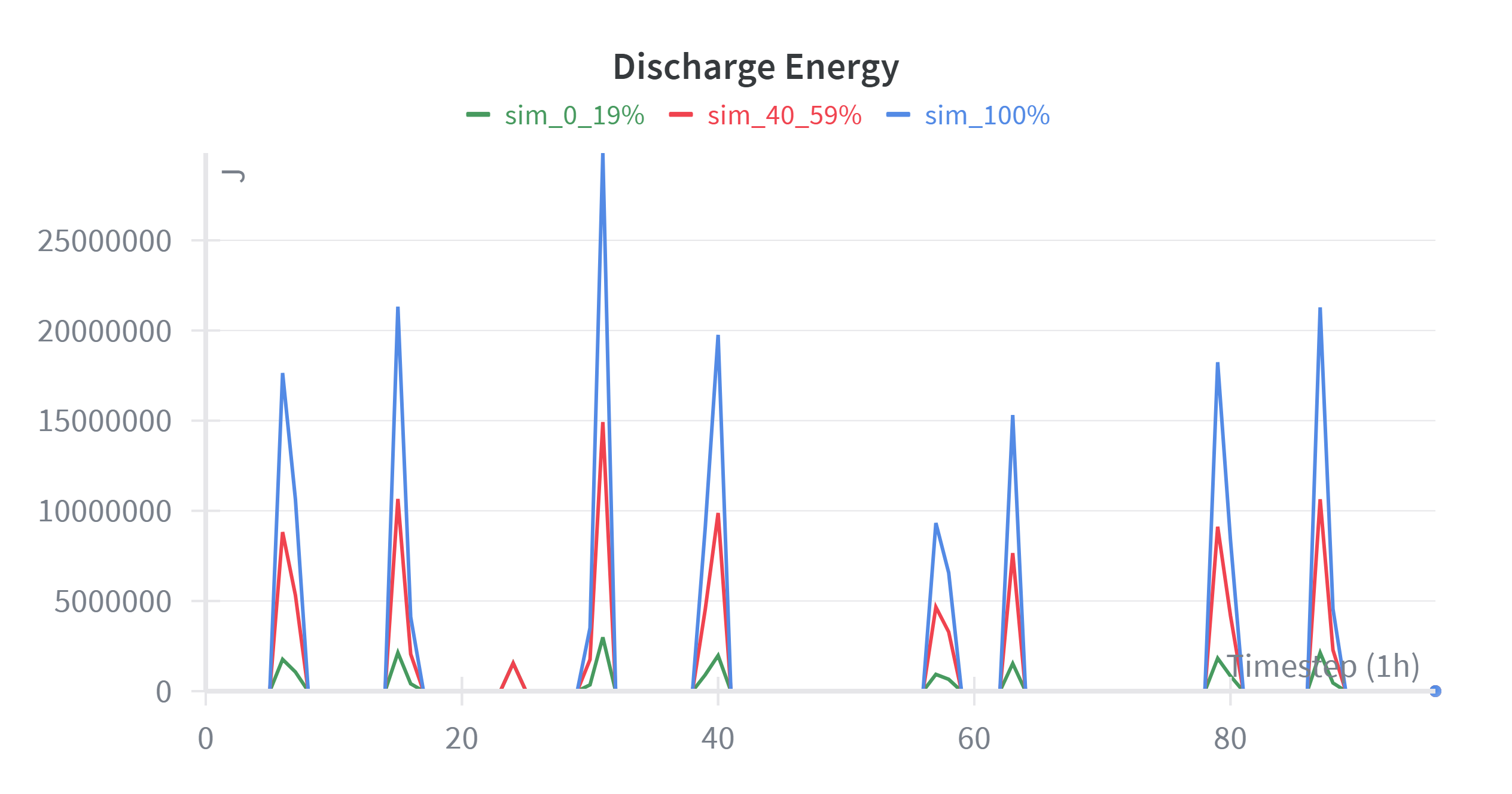
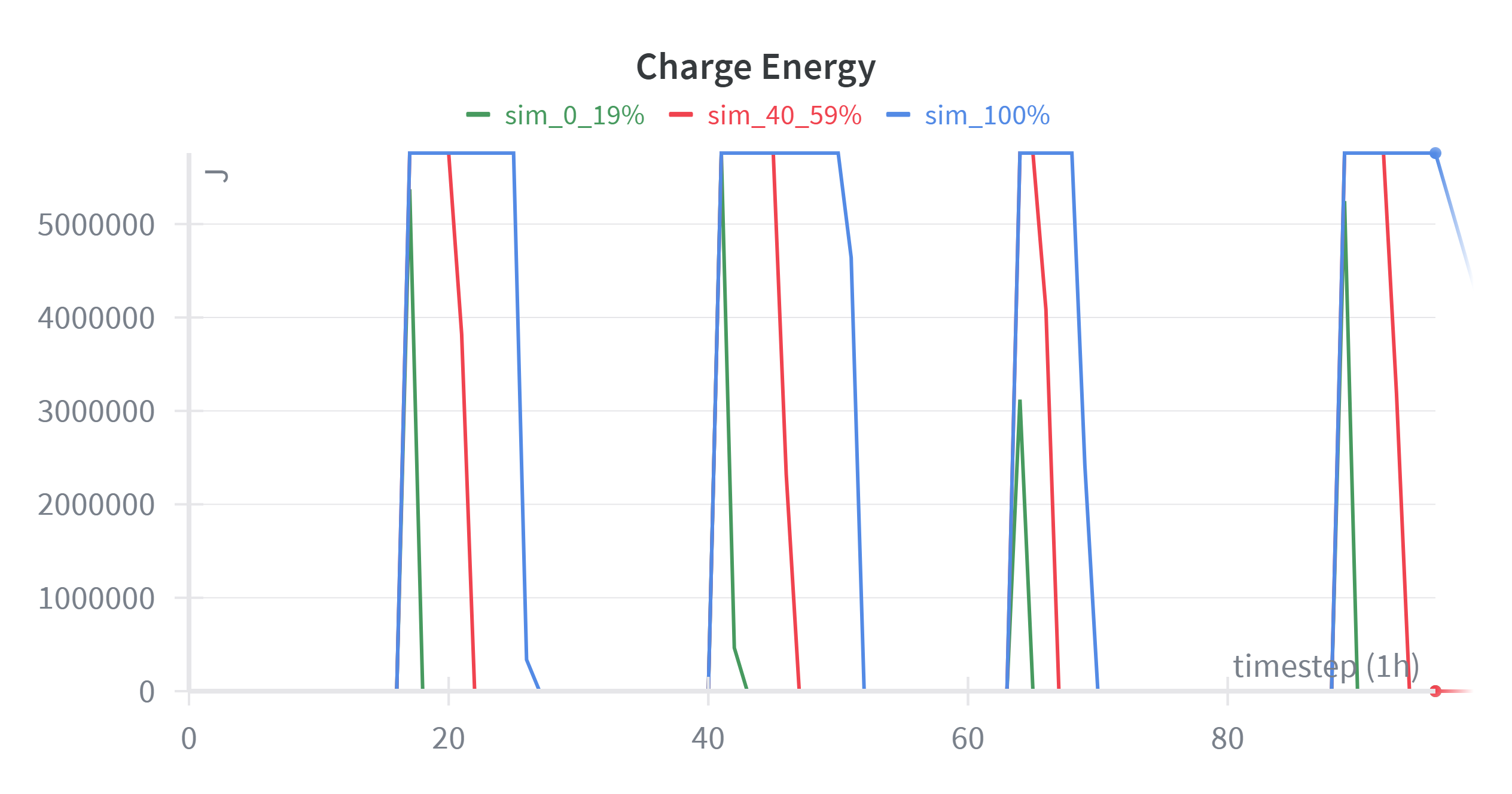
I have some results now. I simulated the same building with different fraction (100%, 40-59% and 0-19%). I got these figures for the first 5 days.

image description image description

It seems like it reduces the charging energy by the amount of energy with respect of the mean of the fraction. As the amount of energy for discharging and charging are close (in order to get the same level of battery charge for example for an EV), then it reduces both charging and discharging energy with the amount of energy with respect of the fraction. Here are some results for the entire year :

1 year - 100% :

E_ch = 24815833261.02579 J E_dis = 24839745141.085274 J

1 year - 40-59% :

E_ch = 12419536936.354237 J (ratio 40-59% / 100% ~ 0.5) E_dis = 12424837530.810143 J (ratio 40-59% / 100% ~ 0.5)

1 year - 0-19% :

E_ch = 2483722503.147503 J (ratio 40-59% / 100% ~ 0.1) E_dis = 2491556018.756907 J (ratio 40-59% / 100% ~ 0.1)

Please feel free to correct me if I am wrong. Thank you !

edit flag offensive delete link more

Your Answer

Please start posting anonymously - your entry will be published after you log in or create a new account.

Add Answer

Training Workshops

Question Tools

1 follower

Stats

Asked: 2025-12-04 14:43:42 -0600

Seen: 72 times

Last updated: yesterday