
Question-and-Answer Resource for the Building Energy Modeling Community
 | 1 | initial version |
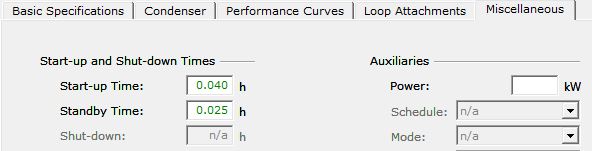
This discrepancy is caused by the start-up and shut-down times inputs in the Miscellaneous tab of the chiller properties. When the defaults are left alone, the start-up time is 0.040 h, and the standby time is 0.025 h.
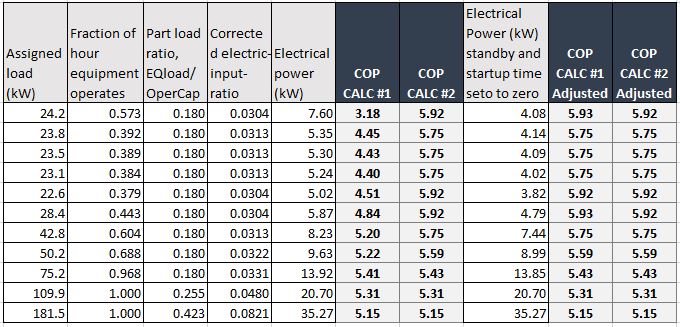
When the chiller cycles there is additional electrical power associated with the startup and standby. This increases the electrical power value and means that COP Calc #2 above is no longer valid.
To verify this, I zeroed out the start-up time and the standby time. Once this is done, the electrical power decreases and COP Calc #1 equals COP Calc #2.
Though it is important not to zero out this value as it is a very real energy usage that affects the effective COP of the chiller plant.
| | 2 | No.2 Revision |
This discrepancy is caused by the start-up and shut-down times inputs in the Miscellaneous tab of the chiller properties. When the defaults are left alone, the start-up time is 0.040 h, and the standby time is 0.025 h.
When the chiller cycles there is additional electrical power associated with the startup and standby. This increases the electrical power value and means that COP Calc #2 above is no longer valid.
To verify this, I zeroed out the start-up time and the standby time. Once this is done, the electrical power decreases and COP Calc #1 equals COP Calc #2.
Though it is important not to zero out this value as it is a very real energy usage that affects the effective COP of the chiller plant.
One thing I didn't figure out, though, is exactly how eQuest is calculating the addtional electrical power.
| | 3 | No.3 Revision |
This discrepancy is caused by the start-up and shut-down times inputs in the Miscellaneous tab of the chiller properties. When the defaults are left alone, the start-up time is 0.040 h, and the standby time is 0.025 h.
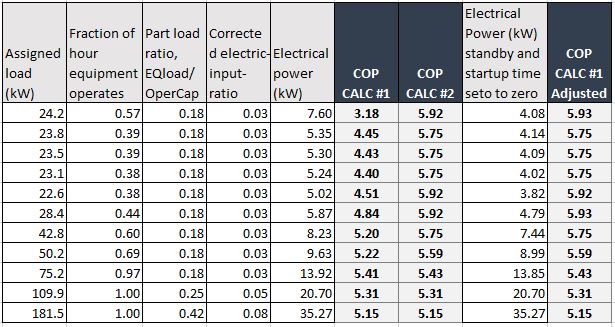
When the chiller cycles there is additional electrical power associated with the startup and standby. This increases the electrical power value and means that COP Calc #2 above is no longer valid.
To verify this, I zeroed out the start-up time and the standby time. Once this is done, the electrical power decreases and COP Calc #1 equals COP Calc #2.
Though it is important not to zero out this value as it is a very real energy usage that affects the effective COP of the chiller plant.
One thing I didn't figure out, though, is exactly how eQuest is calculating the addtional electrical power.
| | 4 | No.4 Revision |
This discrepancy is caused by the start-up and shut-down times inputs in the Miscellaneous tab of the chiller properties. When the defaults are left alone, the start-up time is 0.040 h, and the standby time is 0.025 h.
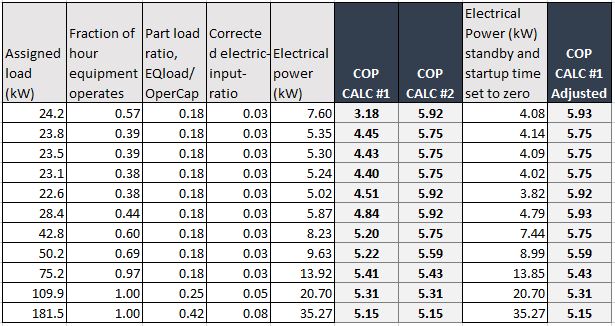
When the chiller cycles there is additional electrical power associated with the startup and standby. This increases the electrical power value and means that COP Calc #2 above is no longer valid.
To verify this, I zeroed out the start-up time and the standby time. Once this is done, the electrical power decreases and COP Calc #1 equals COP Calc #2.
Though it is important not to zero out this value as it is a very real energy usage that affects the effective COP of the chiller plant.
One thing I didn't figure out, though, is exactly how eQuest is calculating the addtional electrical power.
| | 5 | No.5 Revision |
This discrepancy is caused by the start-up and shut-down times inputs in the Miscellaneous tab of the chiller properties. When the defaults are left alone, the start-up time is 0.040 h, and the standby time is 0.025 h.
When the chiller cycles there is additional electrical power associated with the startup and standby. This increases the electrical power value and means that COP Calc #2 above is no longer valid.
To verify this, I zeroed out the start-up time and the standby time. Once this is done, the electrical power decreases and COP Calc #1 equals COP Calc #2.
Though it is important not to zero out this value as it is a very real energy usage that affects the effective COP of the chiller plant.
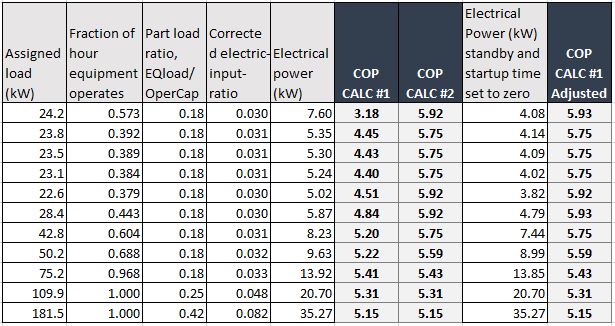
One thing I didn't figure out, though, is exactly how eQuest is calculating the addtional electrical power.


