Question-and-Answer Resource for the Building Energy Modeling Community
Get started with the Help page
Ask Your Question
2

Very low COP values for VRF cooling and heating

asked 2026-03-13 12:31:01 -0500

TTQI_ML's avatar

Hi,

Using OpenStudio, I am modeling an office space which is cooled and partially heated by a VRF system. The VRF system is linked to 3 terminals, each managing a different thermal zone. Since I only have access to minimal manufacturer data, most of the performance and capacity curves were made constant, with the exception of the ''VRFHeatEIRFT'' curve with coefficient 1 = 1.208 and coefficient 4 = -0.03344. Despite the calculated COP values according to my formulas ranging from 1.2 to 3.5 across the outdoor temperature range in heating and a constant COP value of 2.5 in cooling, OpenStudio returns COP values between 0.3 and 0.8 throughout the year.

Despite this problem, the VRF fulfills the cooling load. However, the resulting electrical consumption is exaggerated.

The defrost operation is set to ReverseCycle with a timed value of 0.05. Basin heater capacity was set to 0W, and all other capacity and EIR curves were set to coef 1 = 1, Coefs 2-6 = 0. Piping correction factors were reduced to 0. The unit is hard sized to 8320W in cooling and heating, with a cooling load reaching 2000 W and heating loads reaching 3000 W. COP values range between 0.06 and 0.65 in cooling and between 0.33 and 0.8 in heating .

What other factors impact the resulting COP? What could explain such low COP values, especially in heating?

Thanks.

edit retag flag offensive close merge delete

1 Answer

Sort by » oldest newest most voted
5

answered 2026-03-14 07:02:13 -0500

Keigo's avatar

all other capacity and EIR curves were set to coef 1 = 1, Coefs 2-6 = 0.

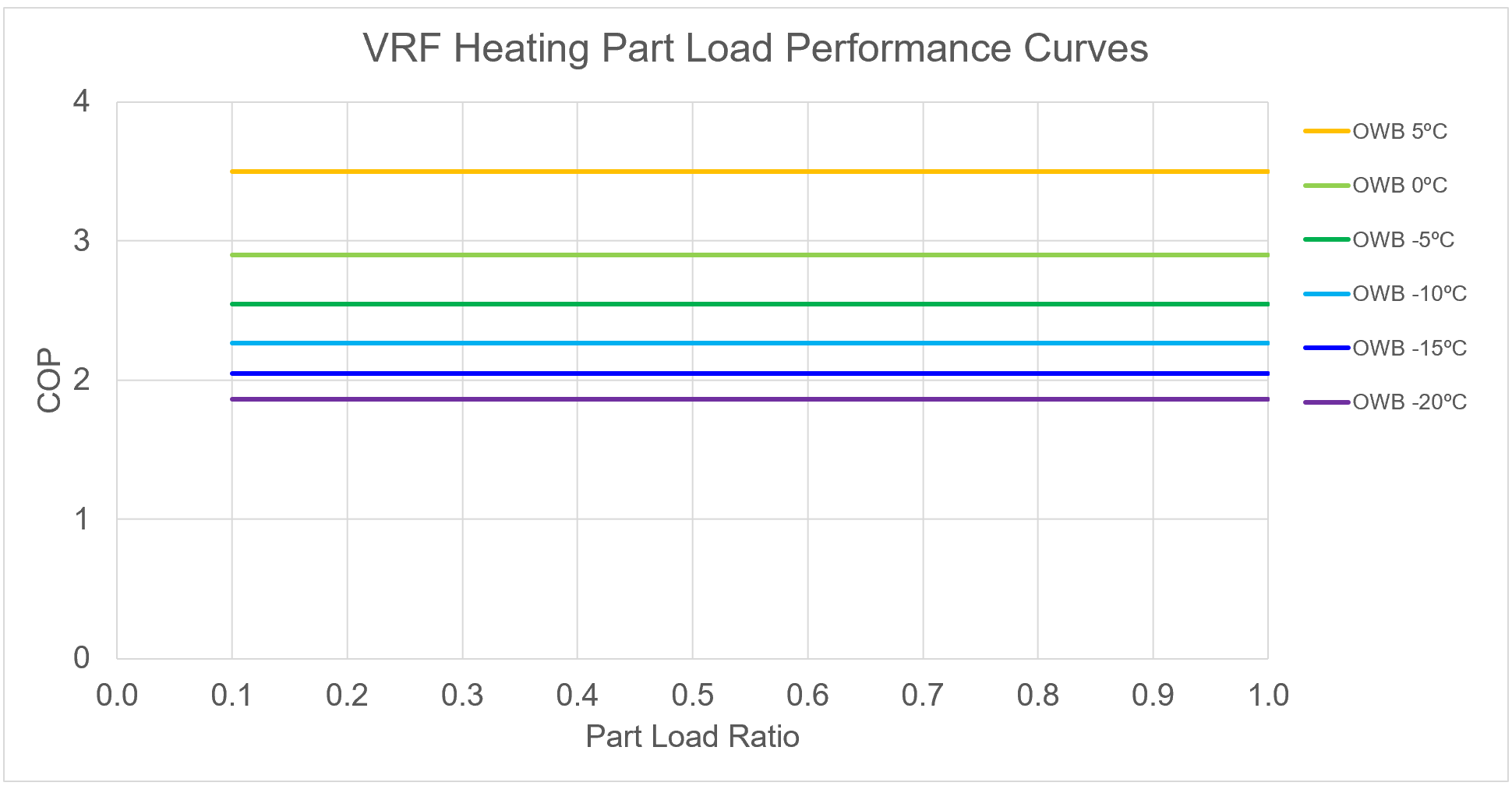
That's inappropriate. For EIRFPLR, if you want to get a constant COP regardless of part load ratio, set Coef 1 = 0, Coef 2 = 1, Coefs 3-4 = 0.

image description

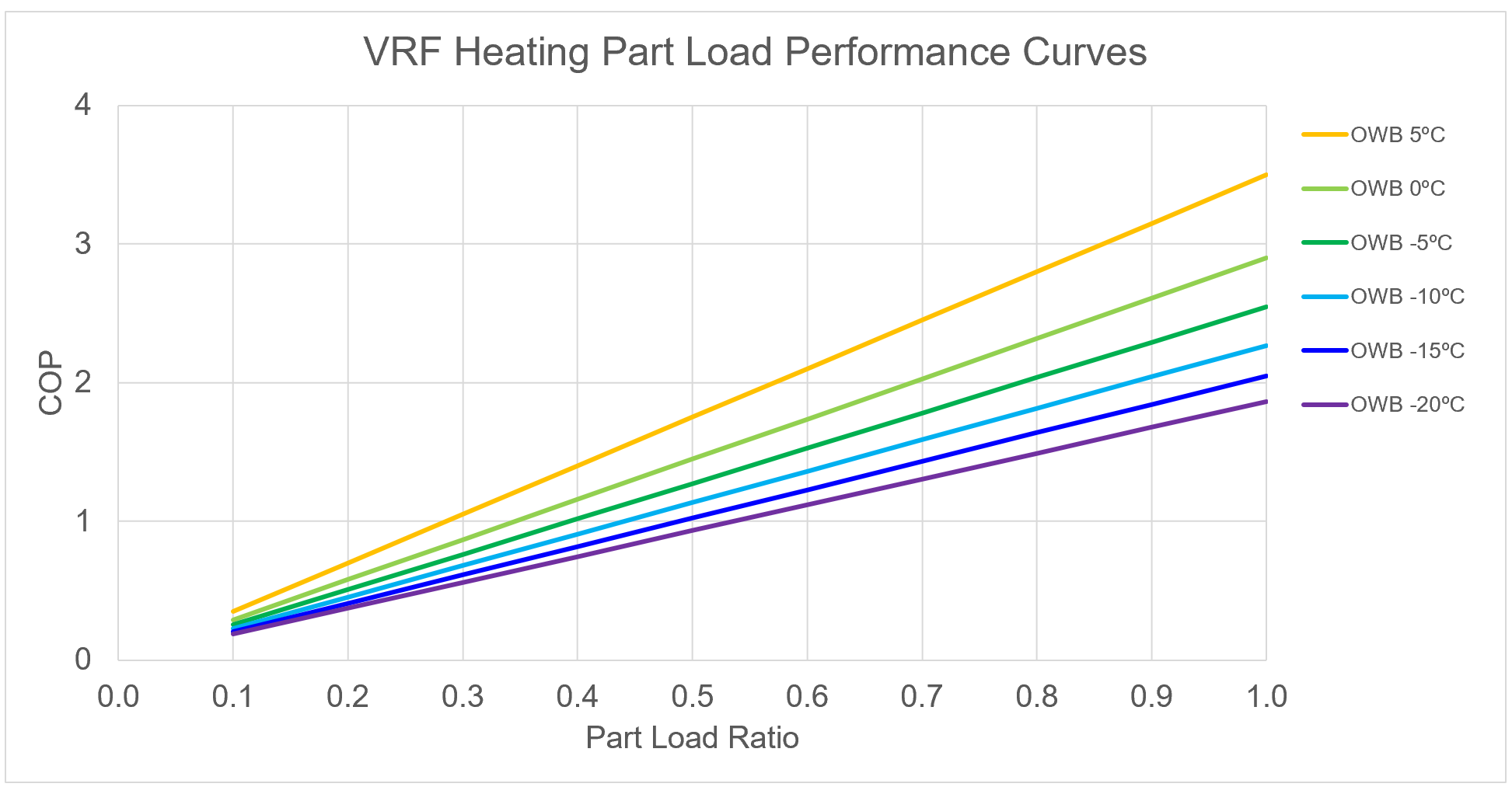
Setting Coef 1 = 1, Coefs 2-4 = 0 would result in the COP proportional to PLR as shown below. You have low PLR (< 3000W/8320W = 0.36). The COP decreases accordingly.

image description

That's the biggest factor, but you can also double-check your Coefs of HeatEIRFT (i.e., Coef 1 = 1.208, Coef 4 = -0.03344). I couldn't reproduce COP ranging 1.2 to 3.5 with your setting. You can refer to this paper to correctly calculate curve coefficients.

edit flag offensive delete link more

Comments

This actually seems to be the problem. However, I still do not understand the logic behind the EIR curves. In another system, I am using a HeatPump:PlantLoop:EIR object and the EIR is defined according to the logic EIR = (1/RatedCOP)·EIRFPLR·EIRFT. I was able to accurately characterise the heat pump COP as a function of both EIR and PLR. In this logic, when I wanted to keep a value constant, I could simply use coef 1 = 1 ; Coefs 2-6 = 0. I could also control the EIR as a function of condenser and evaporator temperature (Coefs 2-6 =/= 0). Does the VRF curves behave differently? Thanks

TTQI_ML's avatar TTQI_ML  ( 2026-03-17 08:05:07 -0500 )edit

My understanding is similar to the logic shown in page 29 of the article linked. When characterising a constant value for Cooling Energy Input Ratio Modifier Function of High Part-Load Ratio, the author suggest using a constant coefficient (Coef 1 = 1; Coefs 2-4 = 0). Albeit the curve is for a high part-load ratio, the logic should hold for low part load ratios.

TTQI_ML's avatar TTQI_ML  ( 2026-03-17 08:12:11 -0500 )edit

Page 29 mentions the flat part where PLR exceeds 1 in Figure 8 on page 26. The vertical axis of Figure 8 is power input, not COP. The flat part indicates that as PLR increases, COP increases and power input remains the same. This is different from your case.

Please try it for yourself. You can generate 4 coefficients of EIRFPLR by regression analysis with Excel. For example, PLR = 1, 0.8, 0.5 and 0.2. The corresponding ratio of operating power to rated power = 1, 0.8, 0.5 and 0.2 because COP is constant. You will get Coef 1 = 0, Coef 2 = 1, Coefs 3-4 = 0.

Keigo's avatar Keigo  ( 2026-03-17 09:57:50 -0500 )edit

Your Answer

Please start posting anonymously - your entry will be published after you log in or create a new account.

Add Answer

Sponsor

Training Workshops

Question Tools

1 follower

Stats

Asked: 2026-03-13 12:31:01 -0500

Seen: 167 times

Last updated: Mar 17